
Components for distributed fiber sensing, FBG interrogation and cable monitoring — MEMS switches, circulators and in-line power monitors that expand channel count, separate launch and return, and support long-term stability.
Discuss your sensing system View sensing componentsFiber sensing systems must recover weak return signals and switch repeatably between multiple points or cables. Insertion loss, isolation and repeatability affect the measurement itself; outdoor operation adds packaging and long-term reliability requirements.
Distributed sensing measures temperature, strain or vibration through backscatter along the fiber. The return is weak, so every additional decibel of front-end loss consumes link budget, while launch leakage and reflections can obscure the useful signal.
FBG arrays and multi-cable monitoring often share one interrogator. Each time the switch returns to a channel, it must present nearly the same loss, or component variation enters the measurement and complicates comparison between scans.
Sensing hardware may sit along pipelines, in tunnels, in power cabinets or at wellheads, facing temperature changes, humidity and vibration. Devices must remain within specification long after leaving the lab.
TALFOD supplies the passive devices inside sensing and monitoring systems: MEMS switches for channel selection, circulators for launch/return separation, Tap-PD for in-line power monitoring, and specialty switches for endurance or latching requirements.
Distributed sensing: measurement along the fiber. The fiber itself becomes the sensing medium. An interrogator launches probe light and analyzes Rayleigh, Raman or Brillouin backscatter to determine temperature, strain or vibration at different positions. This works well for pipelines, power cables, tunnels and perimeter monitoring.
A 3-port circulator sends the probe into the sensing fiber and routes the weak return to the receiver. Low insertion loss preserves link budget, while high isolation and return loss help limit launch leakage and reflections. For polarization-sensitive systems such as coherent φ-OTDR, PM circulators and PM MEMS switches reduce polarization-related variation.
Tap-PD samples a small fraction of the main path for in-line launch-power monitoring, helping the system identify changes in the source or front end. Hermetically sealed detectors support long-term field operation.
FBG interrogation: reading wavelength as temperature and strain. An FBG reflects a specific wavelength. Stretching, compression or temperature change shifts that wavelength, which the interrogator converts into a measurement. Multiple FBGs with different wavelengths can share one fiber to form a multi-point sensing array.
The circulator sends probe light to the FBG array and routes the reflected signal to the interrogator. When several arrays need to share one instrument, a MEMS switch selects each channel in turn. For frequently scanned systems, switching endurance and repeatability are especially important.
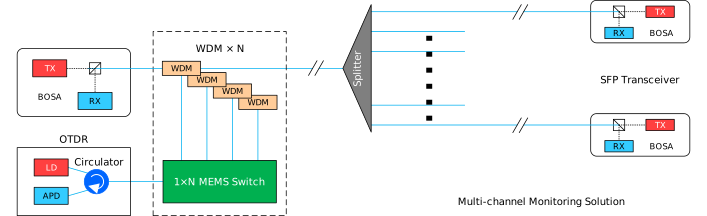
OTDR multi-channel monitoring: one OTDR works with a 1×N MEMS switch to test different cables in turn. WDM lets the probe share the fiber with live traffic, and the circulator routes the return to the receiver.
OTDR uses the return signal to locate breaks, connectors and loss changes. A single OTDR behind a 1×N MEMS switch can test many cables without dedicating an instrument to each branch. Because results are compared with earlier traces, the switch must return to nearly the same loss each time, so component variation is not mistaken for a cable event.
Specialty switches and outdoor reliability. For higher cycle counts or latching requirements, magneto-optical switches offer more than 100 billion cycles without a moving mirror, while mechanical switches provide latching and non-latching options. Wavelength, fiber type and package can be tailored to the installation.
1×N / M×N switches with up to 128 single-mode channels, 10⁹-cycle durability and ±0.05 dB repeatability; PM versions support polarization-sensitive systems.
View details →Standard, mini, PM and 8-in-1 circulators for launch/return separation in sensing front ends, including compact and polarization-sensitive implementations.
View details →ITPD and TAPD devices that sample a small fraction of the main path for in-line power monitoring and front-end diagnostics.
View details →Magneto-optical and mechanical switches for high cycle counts, latching and specialized monitoring or protection paths.
View details →Custom wavelengths, fiber types and package outlines available. Samples ship worldwide.
info@talfod.com
OCS-based optical switching for reconfigurable, high-radix AI cluster networks.
Explore →Miniaturized passives for coherent modules, DCI platforms and line systems.
Explore →Precision optical components for quantum systems.
Explore →Passive and hybrid components — WDM, isolators, tap PDs and MEMS switches — for PON and 5G fronthaul.
Explore →