
Optical components for PON, single-fibre CWDM access and 5G fronthaul — coexistence WDM filters, isolators, tap PDs, full-band circulators and MEMS switches.
Discuss your access network View access-network componentsAccess equipment is deployed in large numbers and in very different environments, from risers and outdoor cabinets to base stations. Devices must withstand temperature and humidity changes while delivering consistent performance at volume.
PON and 5G fronthaul are deployed in large numbers of ports. A TDM-PON split of 1:32 to 1:64 puts dozens of ONUs behind one OLT port, and each port relies on passive devices — WDM filters, isolators and circulators. Insertion loss, wavelength accuracy and reliability must remain consistent across production batches.
Devices in street cabinets, pole-mounted nodes and base stations face temperature swings, humidity and condensation. Suitable sealing and packaging help protect optical performance and service life in these environments.
Campus and in-building networks carry multiple 10G services over limited fibre resources. Transmit and receive share one strand, while wavelengths sit on the CWDM grid. Devices need low insertion loss and PDL across the band, with enough consistency to preserve link margin.
TALFOD supplies the passive devices used in optical access, single-fibre bidirectional links and line monitoring: coexistence WDM filters, isolators, tap PDs, full-band circulators and MEMS switches, backed by controlled production processes for batch consistency.
Coexistence WDM filters: combining, splitting and monitoring on one fibre. PON generations share the same feeder fibre: a GPON/XGS-PON coexistence scheme, for example, must combine and separate downstream and upstream wavelengths — and often a monitoring or OTDR band — without disturbing live services. Dielectric thin-film filters do this with low insertion loss, tight wavelength accuracy and high isolation, so each added service keeps enough link margin on the shared ODN.
Repeatability comes from the process. In a 1:32 to 1:64 TDM-PON, one OLT port serves dozens of ONUs, and a deviation in filter insertion loss or center wavelength in any port eats into the link margin of its branch. The same coating, assembly and screening flow is used for each model to limit batch variation and make volume performance repeatable.
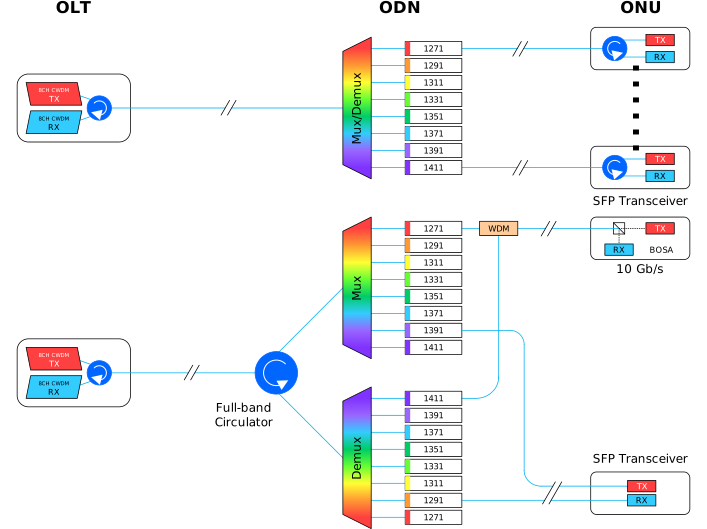
Multichannel bidirectional transmission on one fibre: the OLT combines wavelengths into the ODN, the ONU demultiplexes them, and a circulator separates transmit and receive. TALFOD supplies the WDM filters and circulators along the path.
Full-band circulator: 16-wave CWDM over a single fibre. A circulator uses non-reciprocal transmission to separate the two directions: light entering port 1 exits port 2, while received light entering port 2 is routed to port 3. Campus access can carry multiple 10G services over one fibre using a 16-wave CWDM scheme. Our full-band circulator uses a single-circulator design to support the 16-wave scheme, with low insertion loss, low PDL and stable performance over temperature. For dense line cards, the 8-in-1 package integrates eight circulators to save space and assembly steps.
Reliability where the network gets hard. Devices in street cabinets, pole-mounted nodes and base stations face temperature swings, humidity and condensation. Related WDM, isolator and tap-PD products are validated against Telcordia requirements, with lot-level consistency checks so volume deliveries perform the same in the field as in qualification.
Packaging evaluated per project. Access builds differ in fibre type, connector and enclosure. Related products are packaged and qualified to match each project's operating temperature range and environment, with packaging options assessed case by case rather than assumed from a catalogue.
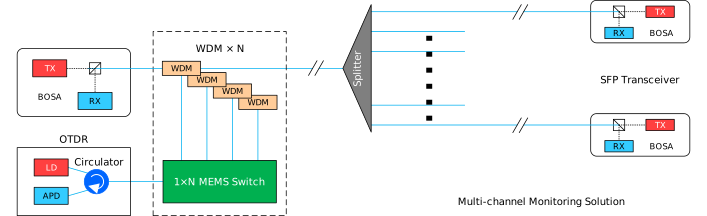
Multi-channel PON monitoring: one OTDR works with a 1×N MEMS switch to select one of N PON lines (ODN feeders) at a time, while the branches behind the passive splitter are measured together and WDM injects the probe light into the live fibre. TALFOD supplies the circulator, MEMS switch and WDM; BOSA endpoint transceivers and the splitter are outside our scope.
A passive ODN cannot report a fault by itself. When a fibre breaks or a connector fails, the management system often sees only a service outage, not the location. An OTDR in the central office, paired with a 1×N MEMS switch, can select the PON line (ODN feeder) under test without sending a technician to every site. Branches behind the passive splitter cannot be selected individually: they are measured together, and the OTDR trace is then used to locate the fault. WDM lets the probe share the fibre with live traffic, while the circulator routes the weak return to the detector; where the monitoring wavelength and isolation allow, routine checks can run while the service stays online.
Full-band circulators for TX/RX separation on one fibre, with the 8-in-1 package integrating eight circulators for dense line cards.
View details →1×N multi-channel switches that work with an OTDR to test PON lines (ODN feeders) and locate faults from the central office.
View details →Custom wavelength plans, channel counts and packaging options available. Samples ship worldwide.
info@talfod.com
OCS-based optical switching for AI cluster networks.
Explore →Components for coherent modules, DCI and long-haul transmission.
Explore →Fiber-optic devices for distributed sensing and measurement.
Explore →Precision optical components for quantum systems.
Explore →